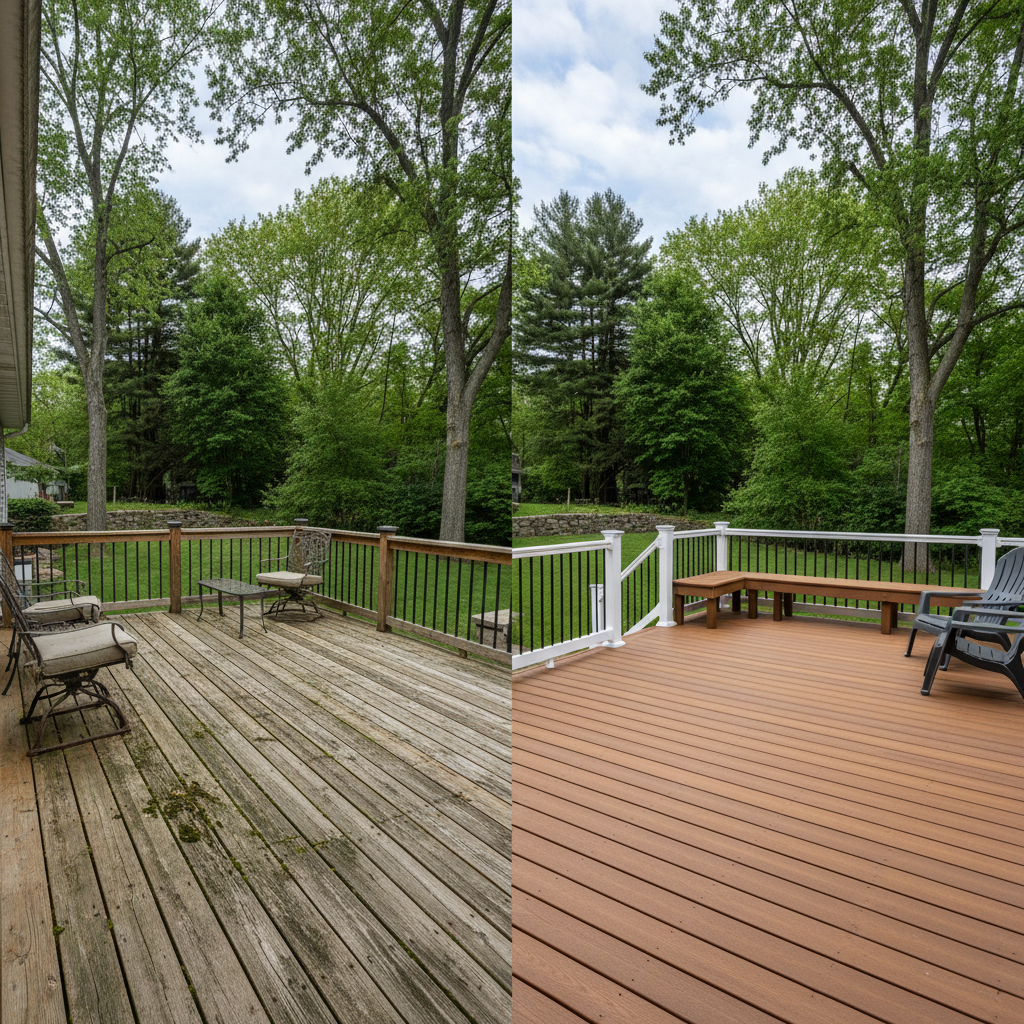
Alright, so you've decided on Trex for your new deck. Smart move, especially with the kind of weather we get here in Manchester – those icy winters and humid summers can really do a number on traditional wood. But just choosing 'Trex' isn't the end of the line. When you're looking at the actual boards, you'll quickly notice two main types: grooved edge and square edge. What's the difference, and which one makes more sense for your backyard oasis?
What's the Deal with Grooved Edge Trex?
Grooved edge boards are designed specifically for use with hidden fastening systems. If you flip one over, you'll see a continuous groove running down both long sides. This groove is where clips slide in, holding the board down to the joists from underneath. The big appeal here is aesthetics – when your deck is done, you won't see a single screw head on the surface of the deck boards. It's a really clean, seamless look, almost like an indoor floor.
From a construction standpoint, using grooved boards with hidden fasteners can sometimes be a bit slower to install than face-screwing, depending on the system. You've got to make sure those clips are seated properly and that your spacing is consistent. But once it's down, it's down. The hidden fasteners also allow for a little bit of expansion and contraction, which is good for composite materials that can move a bit with temperature changes. Here in Manchester, where we see big temperature swings from summer to winter, that flexibility is a plus.
And What About Square Edge Trex?
Square edge boards look just like traditional lumber. They've got straight, flat edges all around. You typically use these when you're going to face-screw the boards directly into the joists, just like you would with wood. You'll see the screw heads on the surface, though many folks choose color-matched screws or plugs to make them less noticeable. We often use square edge boards for the perimeter of a deck, for stair treads, or for fascia boards – anywhere you need a solid edge without a groove.
Installation with square edge boards and face screws is generally quicker. You just lay the board, screw it down, and move on. It's a tried-and-true method. The downside for some is the visible fasteners, which can interrupt the smooth look of the deck. Also, because the screws are driven directly through the board, they hold it very rigidly. While Trex is incredibly stable, extreme temperature fluctuations could theoretically put a bit more stress on the fasteners compared to the slight give of a hidden clip system.
Cost, Durability, and Maintenance
Let's talk brass tacks. In terms of the actual Trex board material, there's usually no significant cost difference between a grooved edge and a square edge board of the same line (e.g., Trex Enhance vs. Trex Transcend). Where the cost comes in is with the fasteners. Hidden fastening systems are almost always more expensive than a box of deck screws. So, if budget is your absolute top priority and you don't mind visible fasteners, face-screwing with square edge boards will likely save you a few bucks on materials and potentially labor.
Durability-wise, both types of boards are Trex, so they're incredibly tough. They resist rot, insects, and splintering. The difference isn't in the board's ability to last, but rather in how the fastening method impacts the overall deck. Hidden fasteners protect the surface of the board from screw holes, which means fewer potential points for water to sit or for the composite material to be compromised. Face-screws, when installed correctly, are also very durable, but you do have those penetrations. Maintenance is identical – a good scrub with soap and water, maybe a pressure wash now and then, and you're good to go.
My Recommendation for Manchester Homeowners
Here's what I tell folks right here in Manchester, especially those living in areas like the North End where older homes might have settling issues or those on properties with heavy clay soil that can shift: If your budget allows, go with grooved edge boards and a quality hidden fastening system for the main deck surface. The clean look is fantastic, but more importantly, the slight flexibility of the hidden clips can be beneficial. It allows the deck boards to expand and contract a bit more freely with our crazy New England weather cycles, potentially reducing stress on the boards and fasteners over the long haul.
That said, don't shy away from square edge boards entirely. They're perfect for those perimeter boards, stair treads, and fascia. Combining the two approaches often gives you the best of both worlds: a beautiful, fastener-free main deck surface and the structural integrity and ease of installation for the edges and stairs. We do this all the time at Manchester Deck Concepts – it's a smart way to build a deck that looks great and lasts for decades.
Ultimately, it comes down to your priorities. Do you want that absolutely pristine, fastener-free look and the subtle benefits of a hidden system? Or is budget a bigger driver, and you're fine with the traditional face-screwed aesthetic? Either way, you're getting a fantastic, low-maintenance deck with Trex. Just make sure you understand these options before we start building.